Most Companies Still Think Cloud Marketplaces Are Procurement Infrastructure. That’s the Problem.

If you already understand what is happening inside AWS and Google Cloud marketplaces, you are ahead of most enterprise software companies.
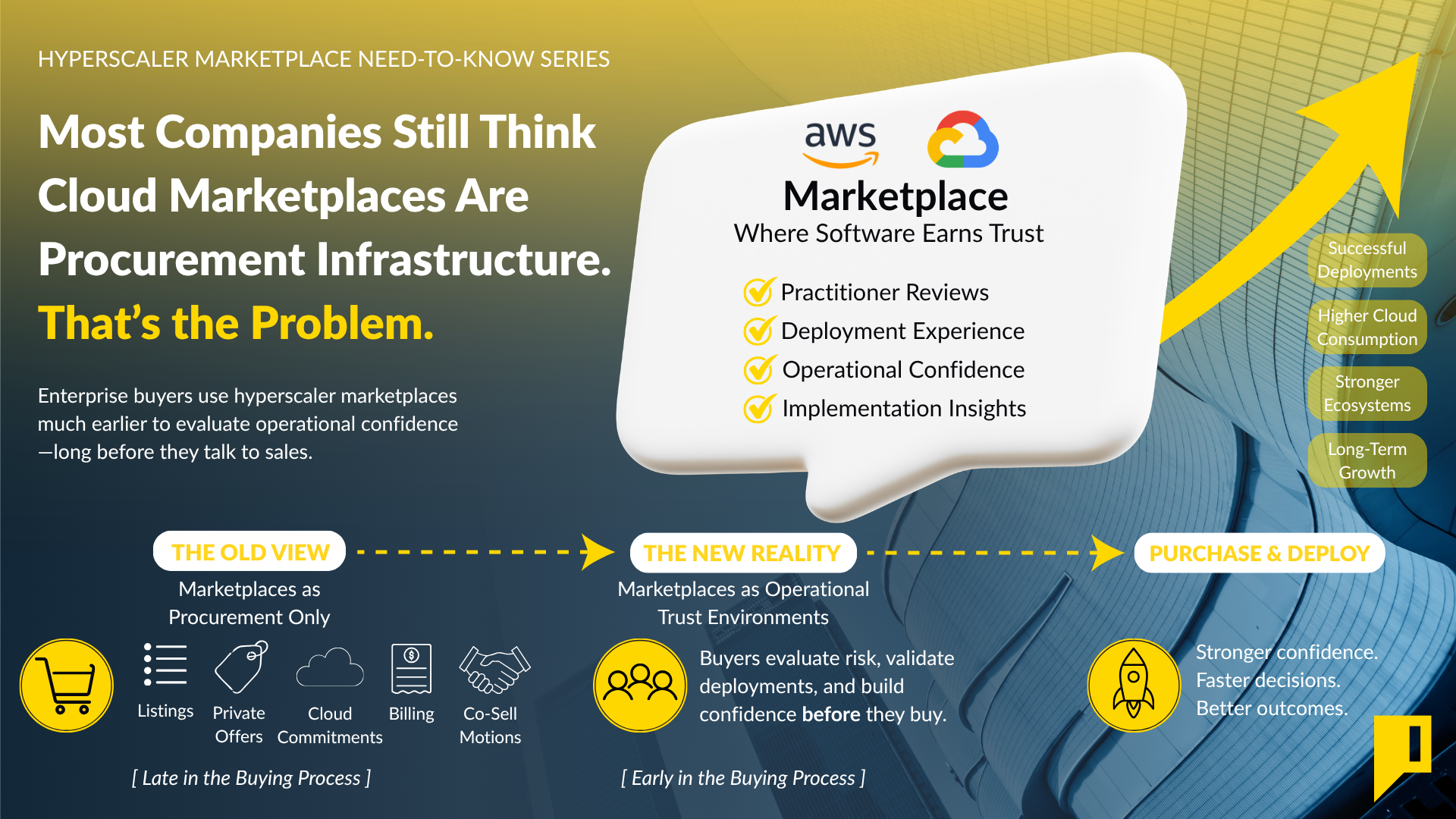
Most vendors still think marketplaces are primarily about procurement. The conversation usually revolves around listings, private offers, cloud commitments, billing simplification, and co-sell motions. Those things still matter, but they no longer explain how enterprise buyers actually use marketplaces today.
What many organizations have not fully recognized yet is that marketplaces have become part of the evaluation process itself. Buyers are not simply showing up at the end of the journey to process a transaction. They are arriving much earlier to determine whether a product feels operationally credible before they ever engage with sales.
That is a significant change in enterprise buying behavior.
In categories like cybersecurity, infrastructure, AI, and cloud operations, buyers increasingly use hyperscaler marketplaces to evaluate deployment maturity, implementation risk, operational fit, and customer experience. The marketplace is no longer just where software gets purchased. It is becoming one of the environments where software earns trust.
Buyers Are Trying to Reduce Operational Risk
For years, enterprise marketing focused heavily on differentiation. Vendors competed on features, innovation, category leadership, and product breadth. Those things still matter, but they no longer answer the question many enterprise buyers care about most:
Will this actually work inside our environment once we deploy it?
That question changes the entire nature of software evaluation.
Nobody gets blamed because a vendor had polished messaging or a strong demo. They get blamed when deployment drags on for months, integrations become difficult halfway through rollout, or operational teams inherit unexpected complexity that becomes painful to manage six months later.
As a result, buyers now spend far more time searching for operational evidence before they ever speak with sales. They want to understand what implementation looked like in real environments, how difficult integrations became, whether support remained responsive after deployment, and if the operational effort ultimately justified the promised ROI.
This is why practitioner insight has become far more influential than polished positioning statements. Buyers are no longer evaluating messaging alone. They are evaluating operational risk.
Why Marketplaces Now Influence Evaluation Earlier
Part of this evolution comes from the scale of enterprise cloud commitments already tied to hyperscaler ecosystems. AWS backlog reportedly sits at $364 billion, while Google Cloud backlog reportedly reached $462 billion and continues growing rapidly.
Enterprises are under pressure to consume that spend efficiently, which naturally pushes procurement teams toward vendors already transactable through marketplace environments. Legal review becomes easier, onboarding moves faster, and billing workflows align more cleanly with existing cloud relationships.
But procurement efficiency alone does not explain what is happening.
Buyers are increasingly using marketplaces during the research and validation phase itself. They are reading reviews, comparing deployment experiences, evaluating operational maturity, and looking for signs that a product will succeed once it reaches production. In many organizations, operational confidence now influences buying decisions long before pricing discussions begin.
Cloud marketplaces have quietly evolved into environments where buyers validate whether a product feels safe enough to operationalize.
Co-Sell Depends on Operational Confidence
One of the biggest misconceptions in enterprise software is that marketplace acceleration happens primarily because procurement becomes easier.
Procurement matters, but operational confidence matters more.
AWS has reported that marketplace deals close 40% faster and are 80% larger than traditional sales motions. Most organizations explain those numbers through transactional efficiency alone. In reality, buyers are often arriving at procurement with far more confidence already established.
By the time serious evaluation begins, many buyers have already consumed practitioner reviews, deployment commentary, operational tradeoffs, and peer validation from organizations similar to their own. That changes the sales conversation dramatically. Instead of spending early cycles establishing credibility, vendors move more quickly into deployment planning, architecture discussions, and operational alignment.
This also explains why hyperscaler field teams increasingly care about operational proof. AWS and Google do not simply want transactions flowing through their ecosystems. They want successful workloads running inside them. Failed deployments hurt everyone involved: the customer, the vendor, and the hyperscaler itself.
Successful implementations create larger cloud consumption, stronger retention, healthier ecosystems, and larger long-term expansion opportunities. Operational credibility has become part of co-sell credibility.
Enterprise Buyers Are Becoming More Careful About Trust
Another important factor driving this evolution is the growing difficulty buyers face when trying to determine what information online is actually trustworthy.
Buyers increasingly seek operational insight through Reddit, LinkedIn, Stack Overflow, and technical communities because they want candid practitioner experiences that traditional vendor marketing often does not provide. At the same time, those environments are becoming more difficult to trust. AI-generated commentary, synthetic engagement, automated sentiment amplification, and stealth promotional behavior are making it harder to separate authentic operational insight from manufactured influence.
This is one reason verified marketplace reviews are becoming significantly more important.
Not all reviews carry the same weight. Validated reviews tied directly to real hyperscaler transactions create a stronger signal because buyers know the reviewer actually purchased, implemented, and operated the product inside a relevant environment.
Enterprise buyers are not looking for generic praise. They are looking for operational specificity. A five-star rating alone does not explain whether deployment became difficult after rollout or whether integration challenges created unexpected operational overhead. Implementation detail is what creates confidence.
AI Is Accelerating This Faster Than Most Companies Realize
AI is making this entire dynamic more important.
Large Language Models increasingly surface practitioner experiences, deployment commentary, and operational tradeoffs instead of polished vendor messaging when buyers research products. Companies with shallow review profiles and limited operational evidence increasingly struggle to appear in AI-assisted buying workflows because AI systems prioritize detailed, structured, experience-based information.
Recent 2026 benchmarks cited in the report show that 44% of B2B SaaS brands are not visible to AI engines because they lack structured third-party proof.
That has major implications for go-to-market teams. Marketplace strategy and AI visibility are no longer separate conversations. The vendors with the strongest operational evidence increasingly become the vendors buyers encounter first.
This Is No Longer Just an Alliance Team Conversation
Many companies still isolate marketplace strategy within alliances or operations teams. That no longer reflects how enterprise buying works.
Marketplace credibility now directly affects buyer trust, shortlist inclusion, AI visibility, co-sell acceleration, deployment confidence, and sales velocity. Operational experience has become part of brand perception.
The companies responding best to this evolution are connecting marketing more closely with customer success, implementation teams, solution architects, and support organizations because deployment reality now directly influences market credibility.
For years, marketing focused primarily on awareness and differentiation. Increasingly, marketing must also help reduce deployment anxiety.
The vendors performing best inside marketplace ecosystems are not necessarily the loudest. They are the most operationally credible. They provide validated practitioner insight, implementation transparency, deployment maturity, operational realism, and contextual peer evidence that buyers can trust.
Their marketplace presence feels less like advertising and more like substantiated proof.
That distinction matters because enterprise buyers are not trying to be impressed at this stage of the buying process. They are trying to avoid failure after purchase.
Cloud marketplaces have become one of the most important operational trust environments in enterprise technology. The vendors that recognize this early will not just perform better during procurement. They will become easier to trust long before the sales cycle even begins.